
Key facts: Hilltop
- The Hilltop's population passed 2,000 by 1900 and 15,000 by 1924 as farmland became subdivisions [1].
- Single-family homes make up about 81 percent of residential land use on the Hilltop [1].
- Project Dry Basement covers an approved backflow device for eligible single and two-family Columbus homes, and owners of eligible rentals can apply [2].
- Columbus homeowners doing their own plumbing work need a homeowner affidavit with their permit application [5].
The housing
A neighborhood of century-old single-family houses
By land area the Hilltop ranks among the biggest Columbus neighborhoods, sitting west of Franklinton and downtown, with I-70 to the north and I-270 to the south and west [1]. It takes its name from the rise once called Sullivant's Hill [1]. West Broad Street, U.S. Route 40, runs through it; the road began in the 1830s as the National Road [1]. In the early 1800s this was farm country. In the early twentieth century, subdivisions grew around the state hospital and the population climbed from about 2,000 in 1900 to 15,000 by 1924 [1].
That growth spurt produced the housing most Hilltop streets still have: modest single-family houses, with multifamily buildings concentrated along the main corridors [1]. Single-family homes account for about 81 percent of residential land use [1]. For drains, it means a large stock of houses of similar age, built over a short period, now reaching the point where original plumbing is near the end of its working life.
Many of these houses were built with cast iron drain lines inside and clay or similar pipe running to the street. Plenty have been updated in pieces since. A kitchen may have new plastic under the sink while the line it feeds into is a hundred years old; a bathroom may have been remodeled without anyone touching the stack. The mix is normal. It just means a clog in one place can have its real cause somewhere older.
Common calls
What drain contractors see in Hilltop homes
Narrowed cast iron lines
Over decades, cast iron builds scale and rust inside [7]. Water still passes, but grease and paper catch on the rough surface and the line slowly closes.
Main line backups at the basement
When the main slows, the lowest drain shows it first. The basement floor drain guide explains what to check before you call.
Toilets that clog for no clear reason
Repeated toilet clogs in an older house can mean a partial blockage further down. Toilet drain clearing starts by ruling that in or out.
Rental turnover problems
Between tenants, drains can collect wipes, grease and hair. New occupants then find the slow drain the last one lived with.
Old pipe
How do century-old cast iron and clay drains wear out?
Cast iron was the standard material for drain and waste lines for generations because it is strong and quiet [7]. Its weakness is the inside surface. Over many years, corrosion and mineral scale build up and the pipe's usable diameter shrinks. The bottom of a horizontal line can also wear thin where water runs. A line in this condition is not necessarily leaking; it is simply rough and narrow, so ordinary kitchen grease and toilet paper catch and build up much faster than they would in a smooth pipe.
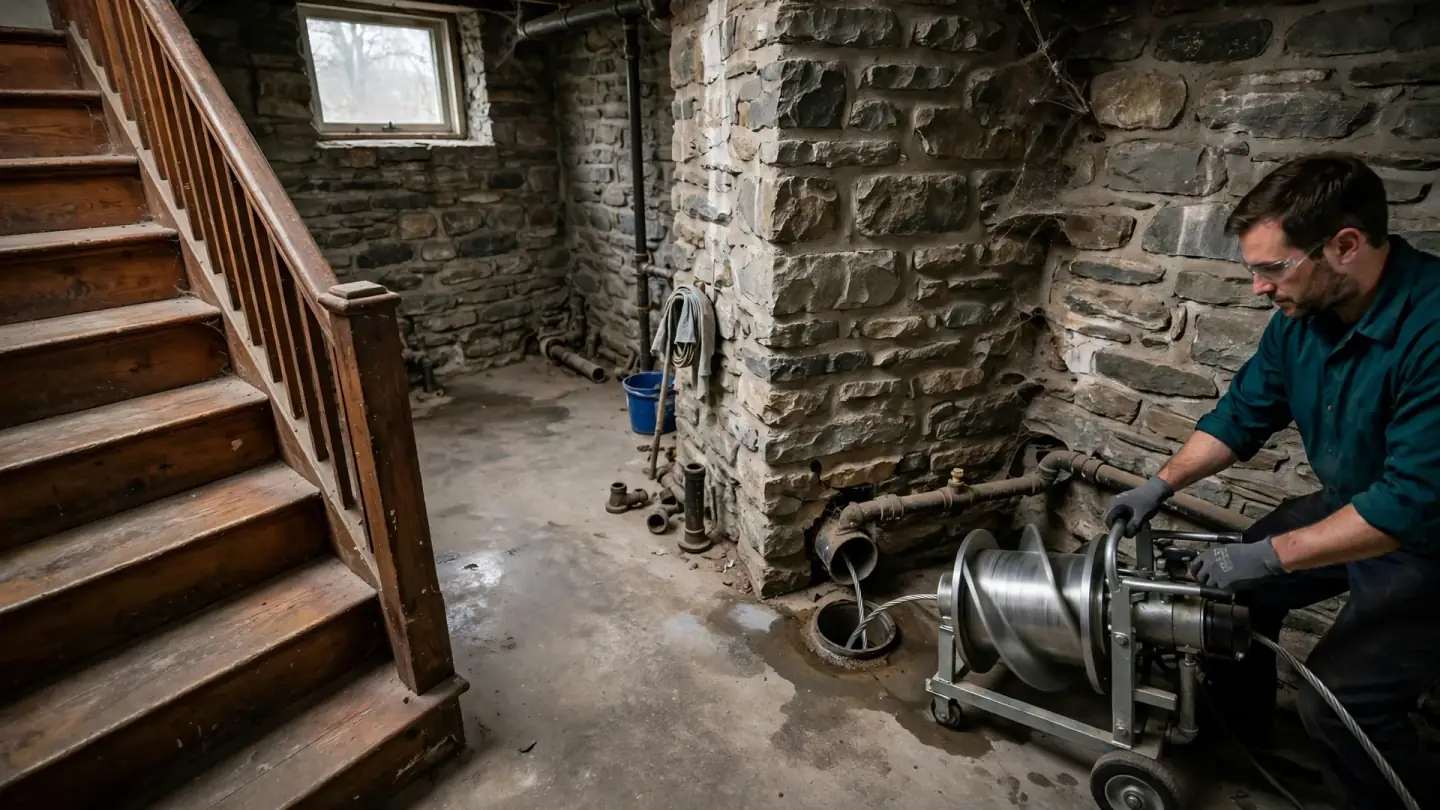
Cleaning narrowed cast iron takes judgment. A cutting head sized to the original pipe can remove buildup and restore flow; an aggressive tool used carelessly on a thin section can damage it. That is one reason to describe the age of the house and any past problems on the call. A contractor who knows the line is a century old will approach it differently from one expecting modern plastic.
Outside the foundation, older laterals in Columbus are often clay. Its joints are where roots and soil movement cause problems. Some houses also had their lateral replaced in the mid-twentieth century, and a few materials from that period, such as Orangeburg fiber pipe, are known to deform over time [8]. If you do not know what your lateral is made of, a drain camera inspection will show you.
Owners and tenants
Who handles a drain problem in a Hilltop rental?
Because the Hilltop is mostly single-family housing [1], a good share of rentals here are whole houses or doubles rather than large apartment complexes. That shapes who calls about a drain. A tenant may be the first to notice a slow line, but the owner usually decides on repairs. When a backup happens, both have something to gain from a clear, early description of the problem.
If you rent, tell your landlord as soon as a drain starts acting up, and stop using fixtures that are backing up. Write down when it started and what you saw. If you own a rental, ask tenants to report slow drains early; a main line that is caught while slow is usually simpler to clear than one that has already backed sewage into the basement.
Project Dry Basement applies to rentals too. The city program pays for a city-approved backflow device at eligible one- and two-unit houses where the public sewer has surcharging in wet weather or from blockages, and if an eligible property is a rental, the property owner can apply [2]. Before anything else, the backup has to be logged with the city sewer maintenance line, 614-645-7102, which never closes [2].
Along the corridors
Apartments and storefronts along West Broad Street
Away from the side streets, the Hilltop's multifamily housing sits mostly along its major corridors [1], with West Broad Street the most prominent. Small apartment buildings, doubles converted into several units and older storefronts with living space above all share a trait: more people draining into lines that were often sized and laid out for fewer. A building that once held one household and now holds four puts four kitchens' worth of grease and four bathrooms' worth of paper into the same lateral.
In buildings like these, a clog in the shared line usually shows up at the lowest unit or in a basement laundry first. Owners of small multi-unit buildings tend to get the most out of a camera inspection, because the footage shows whether the shared line is simply dirty or is sagging, cracked or root-bound. For a storefront with a food business, the commercial side is covered on the commercial drain cleaning page.
Rain and the sewer
Storm backups and keeping rain out of the sanitary line
Older neighborhoods across Columbus share a problem the city's Blueprint Columbus plan was built to address: rain water getting into sanitary sewers through cracked pipes, leaky joints and foundation drains, which can overload the system and back sewage into basements [3]. Blueprint works through four pillars: lining laterals, redirecting roof water, an opt-in sump pump program and green infrastructure [3].
On your own property, the practical questions are where your downspouts go and whether any of them feed an underground pipe near the foundation. If they do, that pipe may connect to the sanitary lateral. During a heavy rain, roof water then competes with household wastewater in the same line. Combine that with a partly blocked old lateral and you have the classic storm-night backup. Mention what you see when you call.
A backflow device helps when the public sewer is the source. It does nothing for a blockage in your own line, which still needs to be cleared. If you do have a device, the city says to inspect and clean it monthly [2].
Before you call
First steps for a Hilltop drain backup
- Stop running water and flushing if any drain is backing up.
- Check the lowest drain in the house, usually a basement floor drain or laundry standpipe, for standing water.
- Do not use chemical drain openers. In old cast iron they add hazard without solving buildup.
- Tenants: tell the landlord right away, in writing if you can.
- If the backup came during or after rain, report it to the city and keep the service request number [2].
- Keep everyone away from sewage-contaminated water and wash hands well after any contact.
Permits
Building permits and city contacts for the Hilltop
The Hilltop is inside the City of Columbus. Columbus Building and Zoning Services issues plumbing permits; its 2026 application asks for the contractor's city registration number [4]. Owners who do their own plumbing need to file a homeowner affidavit, and homeowners may not pull plumbing permits for new construction of a single-family house [5]. Drain cleaning by itself is maintenance. Replacing pipe, adding a cleanout or repairing the lateral are where permits usually apply, and the contractor can tell you on the call which applies.
Any repair that involves digging requires notice to OHIO811 no less than two business days in advance, and private lines like your lateral are not marked [6]. Public sewer questions, including backups you think came from the main, go to Columbus Water & Power through the Sewer Maintenance Operations Center [2].
Planning
Getting a Hilltop house ready for a drain visit
- 1
Describe the symptoms clearly
Which fixtures, since when, worse after rain or not, and any past cleanings. If you rent, say so and whether the owner has approved the call.
- 2
Locate the cleanout
Many older houses have the main cleanout in the basement near where the line leaves the foundation. If you cannot find one, say so; the contractor may work from a fixture or a toilet flange.
- 3
Clear basement access
Move stored items away from the floor drain, standpipe and cleanout. Basements in older houses can be tight.
- 4
Parking and driveway
Note whether there is a driveway or alley. Most Hilltop streets have on-street parking; mention any restrictions.
- 5
Ask for the findings
If the line is inspected, ask what the camera showed and whether the problem is buildup, roots or damage.
Right service
Choosing the right service for an older Hilltop drain
For one slow fixture, start small: clogged drain repair covers sinks, tubs and toilets. For a basement drain that backs up, or several fixtures slowing at once, main sewer line cleaning is the usual first step, ideally with a camera look afterward so you know the line's condition.
In a century-old house, the camera often decides what happens next. Heavy scale with a sound pipe suggests periodic cleaning. Holes, breaks or a collapsed section point toward repair. The replace vs clean guide lays out how that decision usually goes.
If you live just outside the neighborhood, the Hilliard page covers the next city west, and every covered area is listed on the hub.
FAQ
Hilltop drain questions
Why do drains in old Hilltop houses keep clogging?
Original cast iron in century-old Hilltop homes narrows as scale and rust build up inside [7]. The rough, smaller opening catches grease and paper. Much of the neighborhood was built between 1900 and the 1920s [1], so this is common. Cleaning with a head sized to the pipe usually restores flow, and a camera shows how worn it is.
Can a tenant on the Hilltop call about a backed-up drain?
Yes, a tenant can call to describe the drain problem and learn what is likely happening. Repairs are usually the property owner's decision, so tell your landlord quickly and agree who arranges the work. Many Hilltop rentals are whole houses or doubles [1], where the owner is responsible for the sewer lateral.
Can my landlord get Project Dry Basement help for a Hilltop rental?
Yes, the property owner can apply if the rental is an eligible single or two-family Columbus home [2]. The backup must first be logged with the city’s sewer maintenance staff on 614-645-7102 [2]. The program covers an approved backflow device, and the city says to inspect and clean it monthly.
Is it safe to snake an old cast iron drain in a Hilltop house?
Careful cleaning is normal maintenance for cast iron, as long as the cutting head is sized to the pipe. Thin or cracked sections need gentler handling [7], which is why the age of the house is worth mentioning on the call. A camera inspection afterward shows the pipe's condition and remaining wall.
What is Orangeburg pipe and could my Hilltop house have it?
Orangeburg is a fiber pipe used for some sewer laterals in the mid-twentieth century, and it is known to deform over time [8]. Some Hilltop houses had laterals replaced in that era, so it is possible. A camera inspection can identify it; a flattened Orangeburg lateral usually needs repair rather than repeated cleaning.
Do Hilltop homeowners need a permit to fix their own sewer line?
Columbus homeowners doing their own plumbing must file a homeowner affidavit [5], and contractors list their city registration number on the permit application [4]. Simple drain cleaning normally does not need a permit. Digging also requires notifying OHIO811 a minimum of two working days ahead [6].
Why does the toilet gurgle when it rains in my Hilltop house?
A gurgling toilet during rain often means rain water is entering the sanitary sewer and crowding the line. Columbus's Blueprint plan targets this in older neighborhoods: cracked pipes, leaky joints and foundation drains [3]. A partly blocked lateral makes it worse, so cleaning plus a camera check is a sensible first step.
Sources and citations
- [1]Wikipedia: Hilltop (Columbus, Ohio)
- [2]Columbus Water & Power: Project Dry Basement
- [3]Blueprint Columbus: the four pillars
- [4]Columbus Building and Zoning Services: plumbing permit application 2026
- [5]Columbus Building and Zoning Services: homeowner affidavit 2026
- [6]OHIO811: information for homeowners
- [7]Wikipedia: Cast iron pipe
- [8]Wikipedia: Orangeburg pipe