Key facts: Short North
- The Short North runs along High Street between the Arena District and the University District, between Victorian Village and Italian Village [1].
- Most of its buildings are tightly packed early-20th-century brick, and since about 2000 small lots have given way to taller mixed-use buildings [1].
- Columbus food service establishments must keep a FOG Best Management Plan that includes a grease interceptor cleaning log [2].
- Plumbing permits in Columbus come from Building and Zoning Services and the application asks for the contractor's city registration number [4].
The buildings
What Short North buildings look like from the drain's point of view
The Short North is centered on High Street just north of the Arena District, stretching toward the University District, flanked by Italian Village on its east side and Victorian Village on its west [1]. Most of its buildings are tightly packed brick structures from the early twentieth century, and since around 2000 many small lots have been replaced by taller mixed-use buildings [1]. Walk a single block and you can pass a century-old two-story storefront with an apartment upstairs, a restaurant with a full commercial kitchen, and a new building with retail at street level and condos above.
That mix is what makes drains here different from a typical residential street. In an older storefront, the restaurant's kitchen line, the upstairs apartment's bathroom and the building's main sewer connection may all share one path to the street. In a new tower, dozens of units drain into vertical stacks that join a building drain serving shops and restaurants on the ground floor. Either way, a problem on one floor can show up somewhere else entirely.
Older buildings in the district were converted and re-converted over the decades, as the area declined and then revived through the arts community in the 1980s [1]. Each change of use added or moved fixtures. Drain lines in these buildings can therefore include original cast iron, later additions in other materials and connections that do not follow an obvious layout. Before a contractor starts cutting through a blockage, it helps to know as much as you can about what the building has been.
Common calls
Drain problems typical of a dense mixed-use district
Grease in kitchen lines
Restaurant and bar kitchens send fats, oils and grease toward the sewer every service. Grease that gets past the interceptor cools and coats the pipe. Commercial drain cleaning covers these lines.
Interceptors that need attention
A grease interceptor only works when it is pumped and cleaned on schedule. A full one lets grease straight through into the line beyond.
Backups on a lower floor
In stacked units, a blockage in a shared stack shows up in the lowest unit's tub or toilet. The neighbor upstairs may have no idea.
Floor drains in bars and back rooms
Floor drains in service areas collect mop water, fruit pulp and debris. When they slow, the whole floor stays wet. See floor drain cleaning.
Restaurants and bars
What does the Columbus FOG program require from Short North kitchens?
Columbus runs a fats, oils and grease (FOG) control program for food service establishments. Each one must write and follow a FOG Best Management Plan, and a key part of that plan is a log of grease interceptor cleanings [2]. The program exists because grease poured or washed down drains hardens in sewer lines and causes blockages and overflows [2]. In a district with as many kitchens as the Short North, that is not an abstract concern.
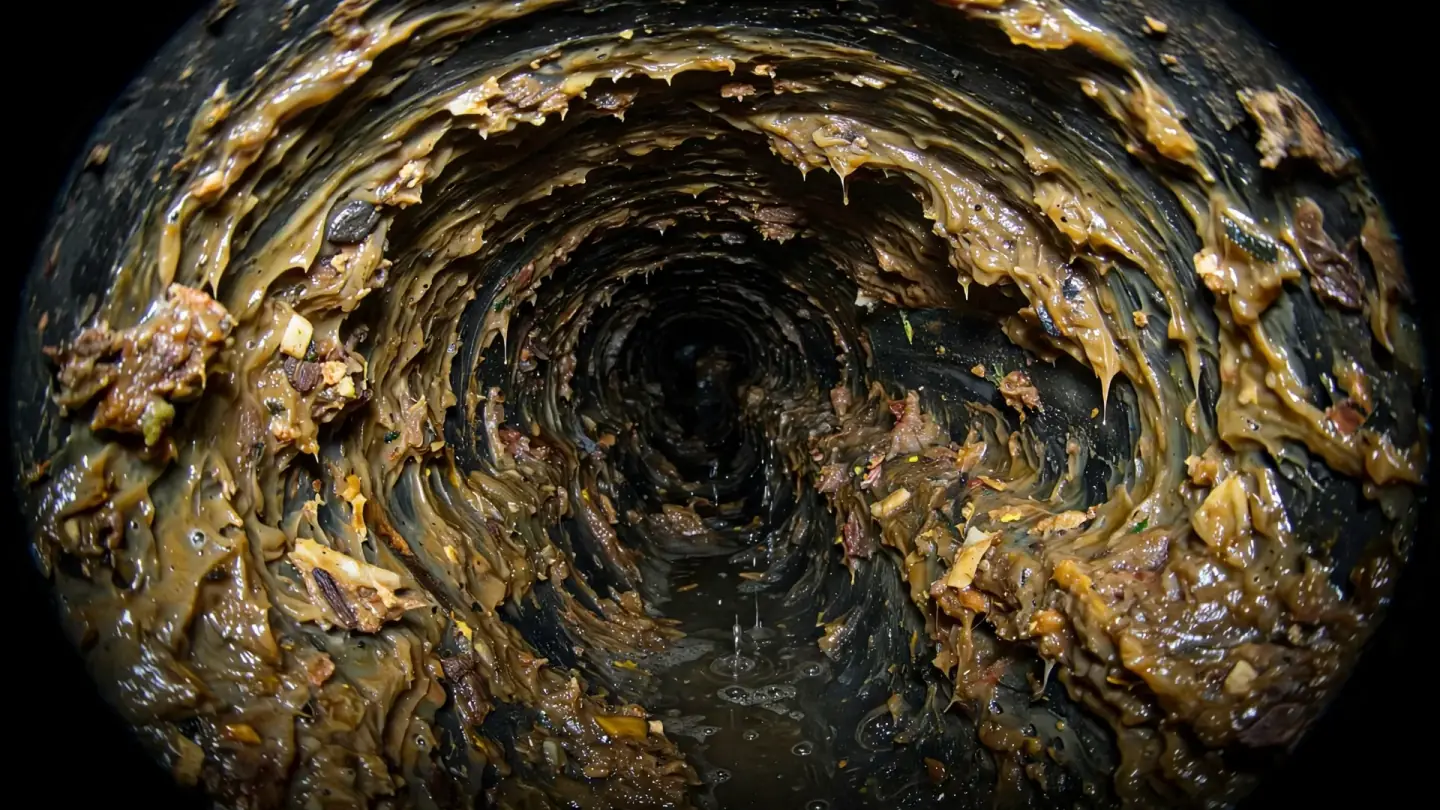
A grease interceptor (also called a grease trap) slows kitchen wastewater so fats float and solids settle before the water leaves for the sewer [3]. It only works while it has room. Once it fills, grease passes straight through and begins coating the line downstream. Left alone, that coating can build into the kind of solid mass sewer crews call a fatberg [7]. Inside a building, the early signs are slow floor sinks, a three-compartment sink that drains sluggishly, and odors near the interceptor.
When you call about a restaurant line, have three things ready: where the interceptor is, when it was last cleaned (your log should say), and which fixtures are slow. The contractor on the call can then judge whether the problem is likely the interceptor itself, the line between the kitchen and the interceptor, or the line beyond it. Cleaning the drain line does not replace pumping the interceptor, and pumping the interceptor does not clear grease already stuck in the pipe; often both are needed.
The public sewer
The sewer under downtown and the High Street corridor
The main sewer that served the downtown area, the Olentangy Scioto Interceptor Sewer (OSIS), was built in the 1930s as a combined sewer, carrying both wastewater and storm water [5]. To relieve it, the city built the OSIS Augmentation and Relief Sewer, a deep tunnel that went into service in 2017 [5]. That work addresses overflows in the big trunk lines; it does not change what happens inside a building's own drains.
Most Short North drain calls are about the private side: a kitchen line, a stack, a floor drain or the building sewer between the foundation and the street. If an entire block reports backups at once during heavy rain, the public system is worth reporting to Columbus Water & Power. If one building or one tenant has the problem, it is almost always in that building's plumbing.
Storefronts
Sewer odors in storefronts that sit empty
Retail spaces in the district change hands, and a storefront can sit empty for weeks between tenants. Every fixture and floor drain has a trap, a bend that holds water to keep sewer gas from coming back into the room [8]. When nobody runs water, that seal evaporates, and a space that was fine last month starts to smell of sewage. Before calling about an odor in a quiet unit, pour a quart or two of water into each floor drain, mop sink and unused fixture and see whether the smell fades over a day.
If it does not, or if the odor is strongest near a wall or ceiling rather than a drain, the cause may be a cracked pipe or a failed vent connection, which is a job for someone who can inspect the line. The sewer smell guide walks through how to narrow it down.
Before you call
What a Short North business or owner should gather
- Which fixtures are slow or backing up, and on which floor.
- For restaurants: the interceptor location and the date of the last cleaning from your FOG log [2].
- Whether other tenants or units have the same problem.
- Who controls the shared plumbing: owner, landlord, association or property manager.
- Where the building cleanouts are, including any in the basement, a back hallway or the alley.
- Your quietest hours, so work on a busy kitchen line can be planned around service.
Permits
Permits, codes and who to contact in the Short North
The Short North is inside the City of Columbus, so plumbing permits come from Columbus Building and Zoning Services. A registered contractor's city number goes on the 2026 permit form [4]. Routine drain cleaning maintains existing plumbing and is usually not permitted work; installing or replacing interceptors, re-piping or sewer repairs are where permits come in. Grease interceptor installation is also covered by the Ohio Plumbing Code, the state plumbing rules in OAC 4101:3 [6], and by the city's FOG rules [2].
Questions about the FOG program, interceptor variances or the Best Management Plan go to the city's FOG team [2]. Questions about the public sewer go to Columbus Water & Power. Questions about the building's own plumbing go to the owner or association first, then to the contractor you're connected with.
Planning
Planning drain work on a busy High Street block
- 1
Pick the timing
Kitchen lines are easiest to work on outside service. Gallery Hop nights and weekends are busy along High Street [1], so mention any event timing on the call.
- 2
Plan the vehicle and hose route
Many buildings have alley access at the rear. Tell the contractor where a work vehicle can stand and how far hoses or cables need to run.
- 3
Get permission for common areas
If the cleanout is in a shared basement or the work involves a stack, confirm access with the association or landlord in advance.
- 4
Protect the space
Clear the area around floor sinks and floor drains, move food and stock away from the work zone, and plan for some water on the floor.
- 5
Record the visit
For restaurants, note the cleaning in your records. For associations, ask for camera footage if the line was inspected.
Keeping lines open
Keeping Short North kitchen and stack lines open
In a restaurant, prevention is mostly routine: scrape plates into the trash, keep strainers in floor sinks, pump the interceptor on schedule and keep the log current [2]. Many kitchens also schedule line cleaning at intervals, often with hydro jetting to remove grease the interceptor missed. Preventative drain maintenance describes how those schedules are usually set.
In residential buildings, the most common culprits are wipes, grease from home cooking and food waste. A short notice to residents about what not to flush and pour does more than most people expect, especially in a building where everyone drains into the same stacks.
For houses rather than storefronts, see the German Village page, or go back to all Columbus areas.
FAQ
Short North drain questions
Does line cleaning count toward my restaurant's Columbus FOG plan?
Line cleaning helps, but the city's required plan centers on grease interceptor maintenance and a cleaning log [2]. Every Columbus food service establishment must write and follow a FOG Best Management Plan [2]. Keep records of both interceptor pumping and line cleaning, and ask the city's FOG team what your plan must show.
Why does my Short North condo tub fill up when the neighbors shower?
Water rising in your tub when others use water usually means a blockage in the shared stack or building drain below your unit. Stop using water and contact your association or building manager, because that pipe is often common property with its own access rules and contractor arrangements.
Can a Short North restaurant get its drains cleaned without closing?
Often, yes, if the work is planned outside service hours. Describe the problem and your schedule on the call so the contractor can say how long a line may be out of use. Gallery Hop nights and weekends are busy along High Street [1], so mention any event timing too.
What is the difference between a grease trap and a grease interceptor?
The two terms are often used loosely for the same job: slowing kitchen wastewater so fats float and solids settle before the sewer [3]. Larger in-ground units are usually called interceptors and smaller under-sink units traps. Installation of either falls under the Ohio Plumbing Code [6] and Columbus FOG rules [2].
Why does an empty Short North storefront smell like sewer gas?
An unused storefront can smell because floor drain and fixture traps dry out, and a dry trap no longer blocks sewer gas [8]. Pouring water into each drain regularly usually fixes it. If the smell continues with full traps, a vent or cracked line may be involved and is worth having checked.
How do grease clogs in Short North kitchens turn into fatbergs?
Grease washed down drains cools, hardens on pipe walls and catches wipes and food solids [2]. Over time that coating can build into a solid mass known as a fatberg [7]. Scraping plates into the trash, keeping strainers in floor sinks and pumping the interceptor on schedule are the main defenses.
Is the old sewer under High Street a reason my Short North basement backs up?
Possibly in heavy rain. The main sewer serving the downtown area, OSIS, was built in the 1930s as a combined sewer [5]. The city added a deep relief tunnel in 2017 to ease it [5]. Still, most single-building backups start in the building's own line, so a cleaning and camera check comes first.
Sources and citations
- [1]Wikipedia: Short North
- [2]City of Columbus: Fats, oils and grease control
- [3]Wikipedia: Grease trap
- [4]Columbus Building and Zoning Services: plumbing permit application 2026
- [5]City of Columbus: OARS deep sewer tunnel
- [6]Ohio Administrative Code 4101:3 (Ohio Plumbing Code)
- [7]Wikipedia: Fatberg
- [8]Wikipedia: Trap (plumbing)